
The Black Art of Grip: A Deep Dive into Motorcycle Tire Compounds
⏱️ 8 min read
TL;DR
An authoritative guide to the chemistry and engineering behind motorcycle tires, exploring how carbon black, silica, and multi-compound technology balance the conflicting demands of longevity and cornering traction.
The Only Thing Between You and the Road
In the world of motorcycling, we often obsess over horsepower figures, lean angles, and suspension clickers. Yet, all that engineering prowess is distilled down to two contact patches no larger than a credit card. Understanding the science of motorcycle tire compounds isn’t just for racers looking for a podium; it is essential knowledge for any rider who wants to maximize safety, performance, and the lifespan of their rubber.
Tire design is a constant battle of compromise. A tire that grips like glue on a racetrack will vanish in 800 miles of highway commuting, while a long-distance touring tire might feel like a wooden hoop when pushed into a deep canyon carve. To navigate these choices, we must look into the chemistry of the ‘black art.‘
The Anatomy of the Compound: Carbon Black vs. Silica
At its most basic level, a motorcycle tire is a complex cocktail of natural and synthetic rubbers, oils, and reinforcing fillers. Historically, the primary filler was Carbon Black. This material gives tires their color and provides structural reinforcement, helping to conduct heat away from the tread and providing high levels of dry mechanical grip. Carbon black excels when the tire is hot, making it a staple of high-performance and racing slicks.
However, carbon black has a weakness: it performs poorly in the wet and requires significant heat to become ‘active.’ Enter Silica. In the last two decades, the infusion of high-silica compounds has revolutionized street tires. Silica allows the rubber to remain flexible at lower temperatures and chemically bonds with water molecules to increase ‘micro-grip’ on wet surfaces. Modern sport-touring tires utilize high silica loads to provide confidence in a rainstorm without sacrificing too much dry-weather stability.
Hysteresis and the Physics of Grip
Grip is generated through two primary mechanisms: indentation and molecular adhesion.
Indentation occurs when the rubber deforms around the microscopic irregularities of the asphalt. This is where the concept of Hysteresis comes in. When the tire deforms, it absorbs energy; as it recovers its shape, it releases that energy. A ‘high-hysteresis’ compound (soft) deforms easily and recovers slowly, creating massive friction (grip) but generating significant heat and wearing quickly.
Adhesion, on the other hand, is a molecular-level bond between the tire surface and the road. This requires the tire to reach its optimal ‘operating window’—the temperature range where the rubber becomes ‘tacky.‘
The Multi-Compound Revolution
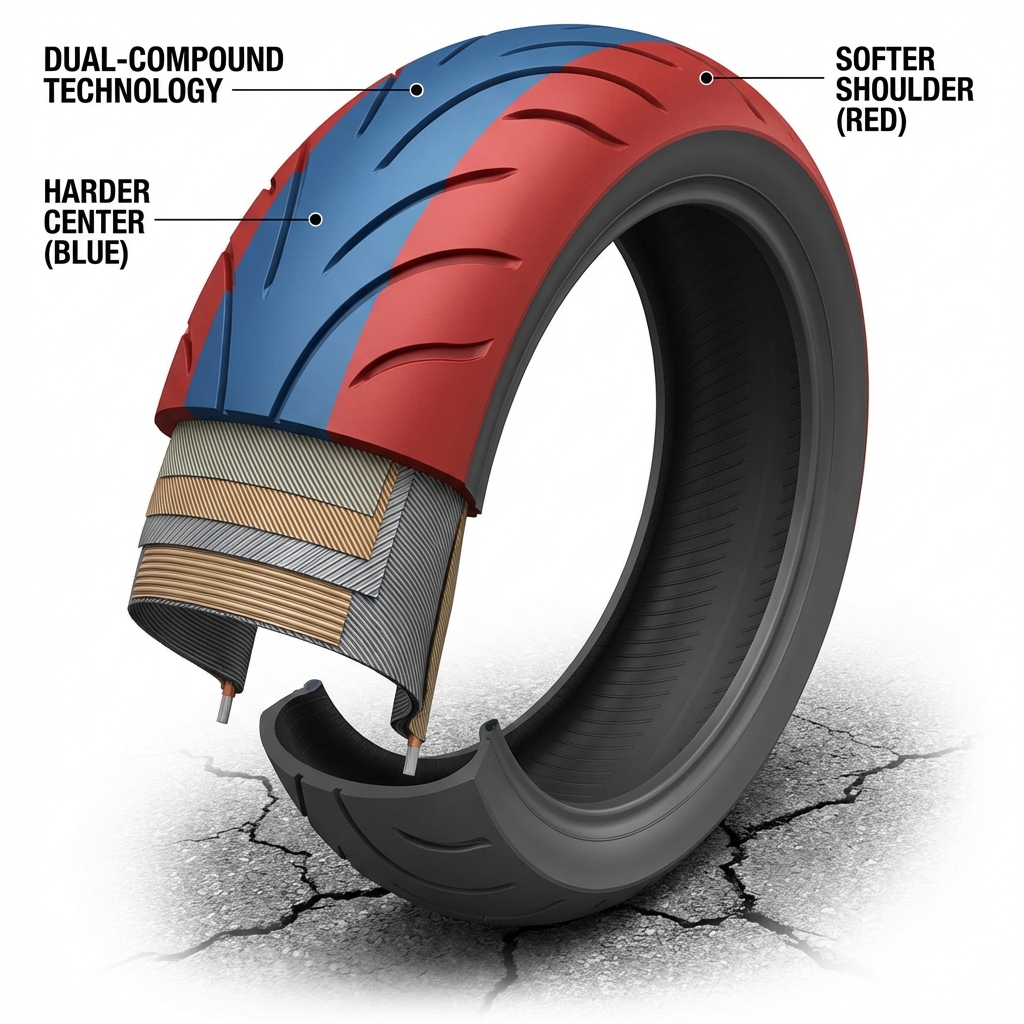
Perhaps the greatest leap in tire technology for the average rider is the advent of Multi-Compound construction (often marketed as 2CT, 3LC, or Cap-and-Base).
In a single-compound tire, the manufacturer has to pick one rubber density. If it’s hard, the tire lasts forever but slides in corners. If it’s soft, it grips corners but the center flattens out after a few highway miles. Multi-compound tires solve this by using a hard, wear-resistant compound in the center ‘tread’ area and a softer, high-grip compound on the ‘shoulders.’
Some advanced tires even use a ‘cap-and-base’ system where a soft grippy layer sits on top of a stiffer, harder base layer. This provides the rider with high traction while the harder base prevents the tire from overheating and ‘squirming’ under heavy loads.
Heat Cycles and the ‘Glass Transition’ Temperature
Every tire has a thermal operating window. For a touring tire, this window is low and wide—it works well from 40°F to 150°F. For a track-oriented ‘hypersport’ tire, the window is narrow and high—it might offer zero grip until it hits 160°F and can safely operate up to 220°F.
When a high-performance tire is heated to its operating temperature and then cooled down completely, it undergoes a heat cycle. Over time, the essential oils (plasticizers) in the rubber migrate to the surface and evaporate. This is why old tires look ‘blue’ or feel hard and plastic-like; they have been heat-cycled out. Even if a tire has plenty of tread left, if the rubber has surpassed its chemical lifespan, it can no longer provide the molecular adhesion necessary for safe cornering.
Choosing the Right Compound for Your Mission
- Commuting & Touring: Look for high-silica, multi-compound tires. These prioritize mileage and wet-weather safety. They reach operating temperature quickly, which is vital for short morning rides.
- Sport/Canyon Riding: Choose a ‘Hypersport’ category tire. These have a higher carbon black content on the shoulders and are designed to withstand the lateral forces of high lean angles without tearing.
- Track Days: These riders should look for ‘Street-Legal Track’ tires or ‘Slicks.’ These require tire warmers to prevent ‘cold tearing’ and are optimized for maximum hysteresis at extreme temperatures.
Conclusion
Understanding tire compounds shifts your perspective from seeing tires as a consumable expense to seeing them as a performance component. By matching the chemical properties of the tire to your specific riding environment, you ensure that those two small contact patches are always ready to handle whatever the road throws at them. Respect the rubber, monitor your pressures, and always remember: your tires are the only thing talking to the road for you. Listen to what they are saying.