Symphony of Power: The Definitive History of the Inline-Four Motorcycle Engine
⏱️ 8 min read
TL;DR
Trace the evolution of the engine configuration that defined the modern superbike. From the 1905 FN Four to the digital precision of today's crossplane screamers, we explore how the transverse inline-four became the dominant force in motorcycling history.
The Architecture of Speed
Few mechanical sounds evoke the same visceral reaction as a high-revving inline-four engine. To many, it is the definitive sound of motorcycling—a smooth, turbine-like hum at idle that transforms into a banshee wail as it approaches a five-figure redline. The inline-four (I4) has become the gold standard for performance, balance, and packaging in the motorcycle world. However, its path to dominance was neither immediate nor inevitable.
The Belgian Pioneer: The FN Four
While many associate the inline-four with Japanese engineering of the 1970s, the story actually begins in 1905 with the Belgian manufacturer Fabrique Nationale (FN). The FN Four was the world’s first production inline-four motorcycle.
Technically, it differed significantly from modern layouts. The engine was mounted longitudinally (the crankshaft running front-to-back), similar to a car. This was necessitated by the final drive, which used a shaft rather than a chain. While it was remarkably smooth for its era, the longitudinal mounting created a long wheelbase, making the bike cumbersome. It also presented cooling challenges, as the rear cylinders were shielded from the wind by the front ones—a recurring theme in I4 development.
The Italian Connection: Racing Pedigree
In the mid-20th century, the inline-four moved from a luxury touring novelty to a racing weapon. Italian marques like Gilera and MV Agusta realized that the I4 offered a superior balance of high RPM potential and a narrow frontal profile if mounted transversely (across the frame).
In 1939, Gilera developed a supercharged, liquid-cooled transverse four that hinted at the future. After World War II, MV Agusta refined this formula, dominating the Grand Prix world. Between 1956 and 1974, MV Agusta’s inline-fours won 17 500cc World Championships. These machines were hand-built, exotic, and prohibitively expensive, but they proved that four cylinders were the key to unlocking maximum horsepower.
1969: The Honda CB750 and the Birth of the Superbike
If there is a single ‘Big Bang’ moment in motorcycle history, it is the 1968 Tokyo Motor Show, where Honda unveiled the CB750. Before the CB750, four-cylinder bikes were either ancient relics or unobtainable racing machines. Honda changed everything by applying mass-production precision to the transverse inline-four.
With an overhead camshaft (SOHC), electric start, and a front disc brake, the CB750 was reliable, leak-free, and terrifyingly fast for its time. It birthed the term ‘Superbike’ and established the ‘Universal Japanese Motorcycle’ (UJM) blueprint. Suddenly, every major manufacturer—Kawasaki, Suzuki, and Yamaha—rushed to develop their own four-cylinder contenders.
The Arms Race of the 70s and 80s
Following Honda’s success, the 1970s saw a massive leap in technical specifications. Kawasaki responded in 1972 with the Z1, a 903cc beast that utilized Double Overhead Camshafts (DOHC), a feature previously reserved for pure racing engines. The DOHC layout allowed for better valve timing and higher rev limits, pushing the I4 into the 80-90 horsepower range.
As the 1980s dawned, the focus shifted from pure displacement to thermal efficiency and aerodynamics. Engines moved from air-cooled to liquid-cooled, allowing for tighter tolerances and more consistent power delivery. The 1984 Kawasaki Ninja 900 (GPZ900R) utilized the engine as a stressed member of the frame and moved the cam chain to the side of the cylinders to make the engine narrower, setting the stage for the modern sportbike era.
The Refinement of the Modern Era
By the 1990s and 2000s, the inline-four reached a state of near-perfection. The introduction of electronic fuel injection (EFI) replaced the finicky banks of carburetors, allowing for razor-sharp throttle response. Engineering milestones like Suzuki’s GSX-R series and the Yamaha R1 pushed the power-to-weight ratio toward the 1:1 mark (one horsepower per kilogram).
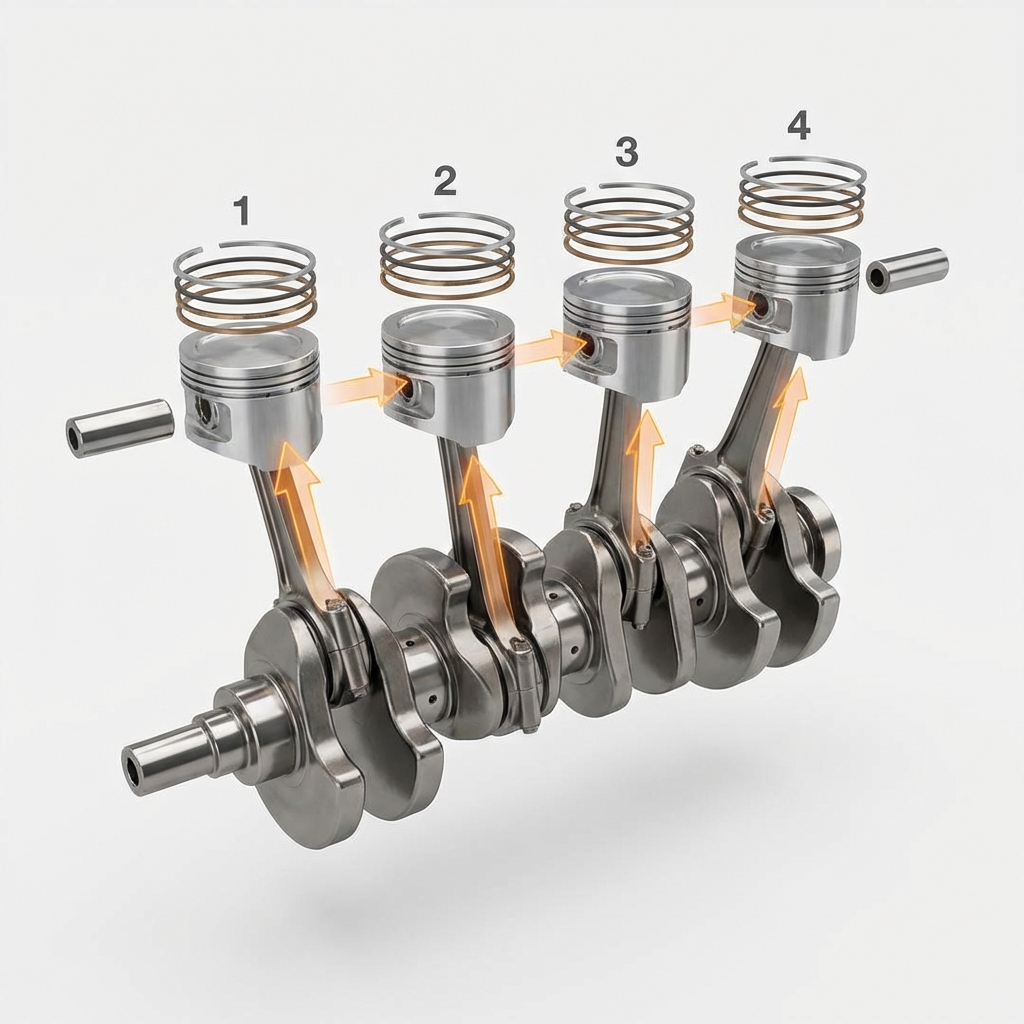
However, the traditional 180-degree ‘flat-plane’ crankshaft had a distinct character: it was efficient but could feel ‘clinical’ or lack traction at the limit. In 2009, Yamaha pioneered the ‘Crossplane’ crankshaft in the YZF-R1, inspired by their YZR-M1 MotoGP bike. By staggering the crankpins at 90-degree intervals, Yamaha created an uneven firing order that mimicked the torque characteristics of a V4 while retaining the packaging advantages of an I4. This ‘Big Bang’ firing order remains one of the most significant modern evolutions of the format.
Why the Inline-Four Endures
Why does the I4 remain the engine of choice for the world’s fastest production bikes?
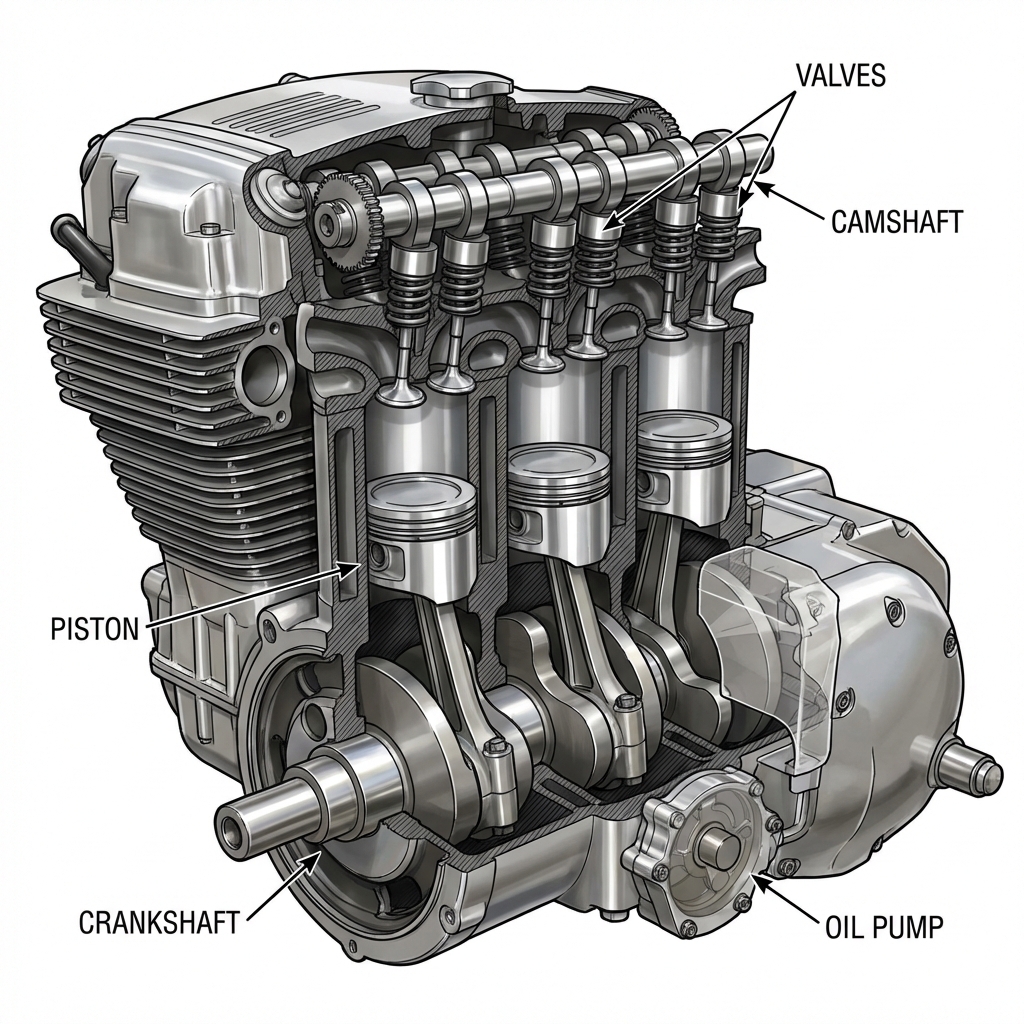
- Primary Balance: The movement of the inner two pistons perfectly counteracts the outer two, leading to inherently smooth operation.
- High RPM: Small, lightweight pistons can move at incredible speeds, allowing the engine to breathe better and produce more top-end power than a twin of the same displacement.
- Cost-Effective Packaging: A single cylinder head, two camshafts, and a simple cooling jacket make it easier to manufacture than a V4, which requires two of everything.
Conclusion
From the cobblestones of Belgium to the high-speed banks of Daytona, the inline-four has evolved from a vibrating curiosity to a digital masterpiece. While the rise of parallel twins (for cost) and V4s (for ultimate racing performance) continues to shape the market, the transverse inline-four remains the beating heart of the motorcycling world—a testament to over a century of engineering obsession.