Mastering the Lean: The Science of Motorcycle Suspension Geometry
⏱️ 8 min read
TL;DR
An in-depth exploration of the critical measurements that define a motorcycle's handling DNA. From rake and trail to swingarm pivots and anti-squat, learn how minute changes in chassis geometry translate to confidence on the road or speed on the track.
The Architecture of Handling
To the casual observer, a motorcycle’s frame is simply a skeleton designed to hold the engine and wheels in place. To an engineer or a professional racer, however, that frame is a complex instrument of physics defined by geometry. Suspension geometry is the invisible hand that dictates how a motorcycle tips into a corner, how stable it feels at triple-digit speeds, and how it communicates the limits of traction to the rider’s fingertips. Understanding these principles is essential for anyone looking to master the art of motorcycle setup.
The Steering Head: Rake and Trail
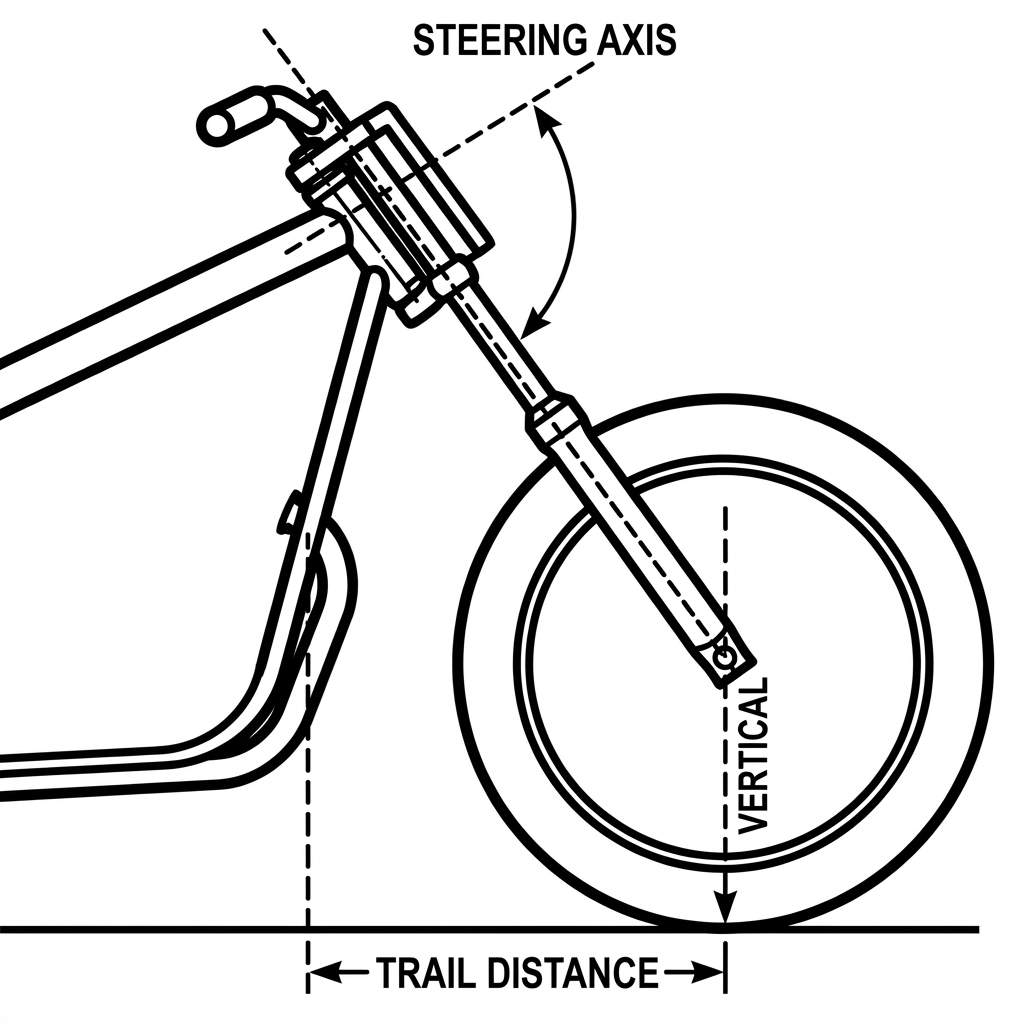
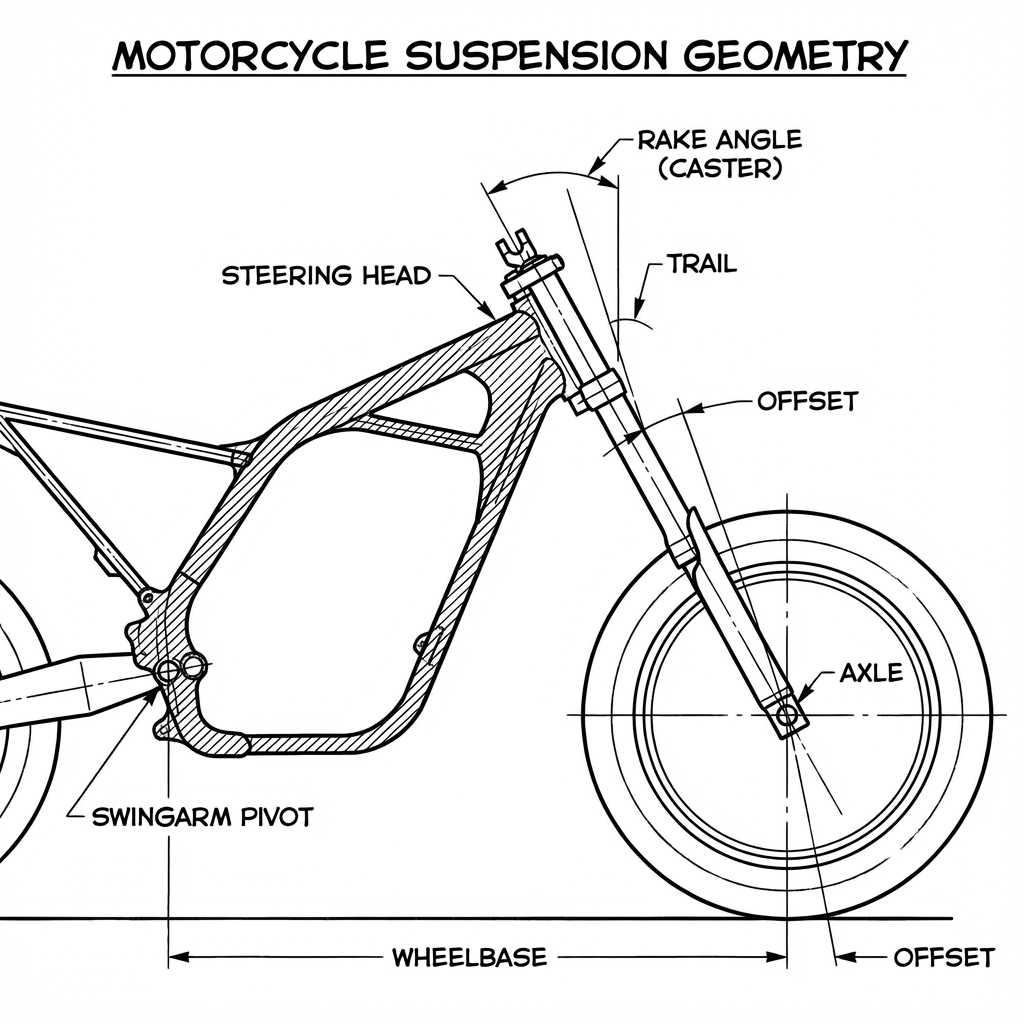
The most fundamental measurements in motorcycle geometry are Rake and Trail. These two figures define the steering characteristics of the front end.
Rake (Steering Head Angle)
Rake is the angle of the steering head measured in degrees from the vertical. A ‘steeper’ rake (a smaller number, such as 23.5 degrees found on modern supersports) allows the bike to change direction with minimal effort. Conversely, a ‘slacker’ rake (such as 32 degrees on a cruiser) increases the wheelbase and provides superior straight-line stability but requires more physical input to initiate a turn.
Trail: The Magic Number
While rake gets most of the marketing attention, Trail is arguably more important for handling feel. Trail is the horizontal distance between the point where the steering axis intersects the ground and the center of the tire’s contact patch.
Think of trail as the ‘caster effect.’ Much like the wheels on an office chair, trail creates a self-centering force. As the motorcycle moves forward, the tire wants to follow the steering axis. More trail results in a bike that feels ‘planted’ and stable, but it also increases the resistance to steering. Less trail makes a bike feel agile and ‘flickable,’ but taken to an extreme, it can lead to instability or ‘tank-slappers’ (high-speed oscillations).
The Role of Triple Clamp Offset
Triple clamp offset is the distance between the center of the steering stem and the center of the fork tubes. This is the primary tool engineers use to fine-tune trail independently of rake. Interestingly, the relationship is counter-intuitive: increasing the offset actually decreases the trail. By moving the forks further forward from the steering stem, the tire contact patch moves closer to the steering axis intersection point. Performance riders often swap triple clamps to find the perfect balance between high-speed stability and mid-corner feedback.
Rear-End Dynamics: Swingarm Angle and Anti-Squat
Geometry isn’t just about the front fork. The relationship between the countershaft sprocket, the swingarm pivot, and the rear axle determines how a bike behaves under power. This is known as Anti-Squat.
When you crack the throttle open, weight transfers to the rear, which naturally wants to compress the shock (squat). However, the tension of the chain pulling on the rear sprocket can actually exert an upward force on the swingarm, depending on its angle.
- Too much anti-squat: The rear suspension becomes stiff under acceleration, leading to a loss of mechanical grip and ‘pumping’ over bumps.
- Too little anti-squat: The rear ‘squats’ excessively, causing the front end to go light, widening your exit line and potentially causing the bike to understeer off the track.
The Dynamic Nature of Geometry
The most challenging aspect of suspension geometry is that it is never static. Every time you brake, accelerate, or lean, the geometry changes.
- Under Braking: The forks compress, the rake becomes steeper, and the trail decreases. This is why a bike feels eager to turn while trail-braking into a corner, but also why it can feel nervous if the forks bottom out.
- Under Acceleration: The forks extend and the rear compresses, increasing rake and trail, which stabilizes the bike as it gains speed.
- Ride Height: Raising the rear of a motorcycle (often by lengthening the shock) steepens the rake and reduces trail, sharpening the handling. Lowering the rear does the opposite.
The Rider’s Influence: Sag and Setup
For the average rider, the most accessible way to manipulate geometry is through Static Sag. Sag is the amount the suspension compresses under the weight of the bike and rider. If your rear sag is too high (the rear is sitting too low), you have effectively ‘raked out’ the bike, making it feel lazy in corners. By adjusting preload to achieve the correct sag, you return the bike to its intended geometric ‘sweet spot.‘
Conclusion
Motorcycle geometry is a game of millimeters. A 2mm change in fork height or a 5mm change in swingarm length can be the difference between a bike that feels like an extension of your body and one that feels like it’s fighting you. By understanding the relationship between rake, trail, and pivot points, riders and tuners can transcend basic ‘clicks’ on a shock and begin to truly engineer their riding experience. Whether you are chasing podiums or simply seeking a more confident Sunday ride, geometry is the foundation upon which all performance is built.