Beyond the Straight Line: The Evolution of Motorcycle Cornering ABS
⏱️ 7 min read
TL;DR
From basic pulse modulation to sophisticated 6-axis inertial sensing, explore how Cornering ABS transformed the 'friction circle' from a theoretical limit into a digital safety net, revolutionizing motorcycle stability during mid-corner braking.
The Physics of the Problem: Why Standard ABS Wasn’t Enough
For decades, Anti-lock Braking Systems (ABS) were designed with a single goal: prevent wheel lock-up during hard braking in a straight line. By using wheel-speed sensors to detect an impending skid, the ABS pump would modulate hydraulic pressure, allowing the tire to maintain traction. However, this system had a fatal flaw—it was effectively ‘blind’ to lean angle.
When a motorcycle leans into a corner, the physics of traction change dramatically. The tire’s ‘friction circle’ is shared between longitudinal forces (braking/acceleration) and lateral forces (cornering). If a rider applies heavy brakes while leaned over with traditional ABS, the system only monitors wheel speed. It doesn’t account for the fact that a significant portion of the tire’s grip is already being used to turn the bike. The result was often a ‘low-side’ crash because the tires exceeded their lateral grip limit before the wheel actually locked, or a ‘stand-up’ effect where the bike suddenly straightened, potentially sending the rider into oncoming traffic or off the road.
The IMU Revolution: Adding a ‘Brain’ to the Brakes
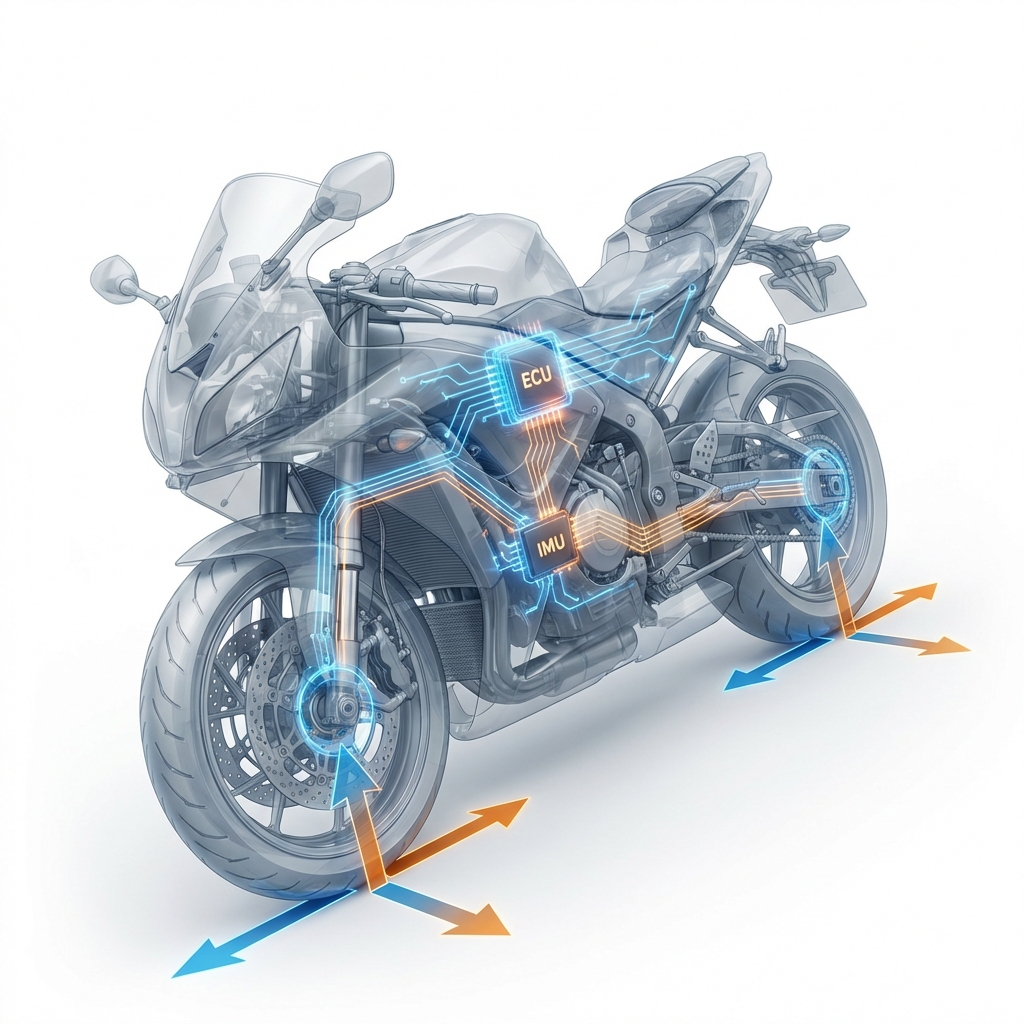
The breakthrough came not from the brakes themselves, but from aerospace technology: the Inertial Measurement Unit (IMU). Around 2013, Bosch introduced the Motorcycle Stability Control (MSC) system, which integrated a sophisticated 5-axis (and later 6-axis) IMU into the motorcycle’s electronics suite.
An IMU measures pitch, roll, and yaw, along with longitudinal, lateral, and vertical acceleration. By processing this data 100 times per second, the ECU (Engine Control Unit) knows exactly how far the bike is leaned, how fast it is leaning, and whether it is diving under braking or squatting under acceleration. This ‘spatial awareness’ allowed engineers to develop algorithms that could calculate the available grip in real-time, adjusting the ABS intervention threshold based on the specific lean angle of the motorcycle.
2013: The KTM 1190 Adventure and the First ‘Cornering ABS’
The KTM 1190 Adventure (2013/2014) is widely recognized as the first production motorcycle to feature Bosch’s MSC. It was a watershed moment for the industry. For the first time, a rider could theoretically grab a handful of front brake mid-corner, and the system would modulate the pressure to maximize deceleration without washing out the front tire or causing the bike to stand up abruptly.
The system works by gradually increasing the ABS intervention as the lean angle increases. At a 45-degree lean, the system is much more sensitive to pressure spikes than it is when the bike is vertical. This ensures that the combined forces of braking and cornering never exceed the total grip available from the tire’s contact patch.
Technical Mechanics: The Friction Circle and Pressure Modulation
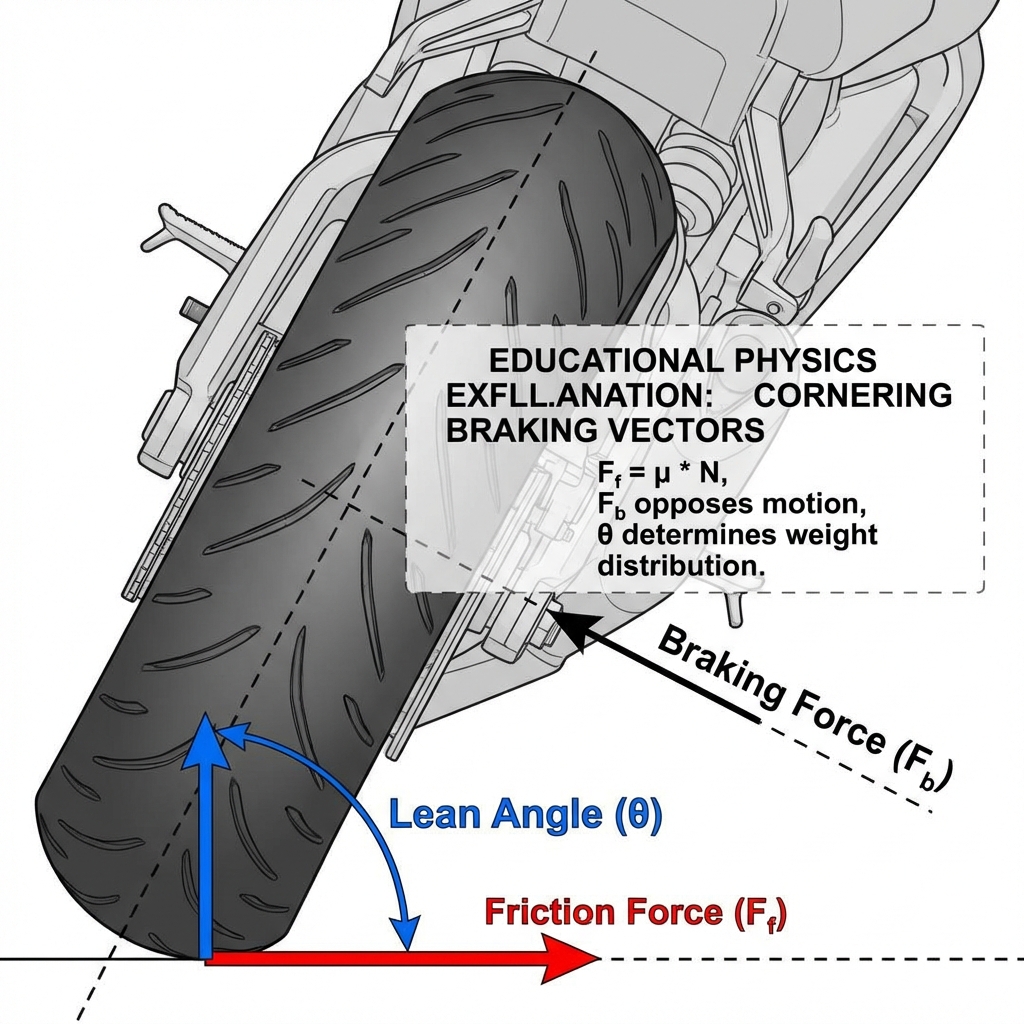
To understand why Cornering ABS is a marvel of engineering, one must look at the modulation logic. In a straight line, ABS allows for nearly 100% of the tire’s friction to be used for braking. As lean angle increases, the ‘available’ friction for braking follows a cosine curve. At a 60-degree lean, very little friction is left for braking.
Modern systems like Bosch’s 10.0 series or Continental’s MK100 MIB do more than just prevent lock-up; they perform ‘Electronic Combined Braking’ (eCBS). When the rider applies the front brake mid-corner, the system may automatically apply a specific amount of rear brake to stabilize the chassis and counteract the bike’s tendency to stand up. This ‘brake torque’ management keeps the motorcycle on its intended line, even under duress.
The Modern Era: From Superbikes to Commuters
What began as an expensive option for flagship adventure bikes and superbikes (like the Ducati Panigale and BMW S1000RR) has rapidly trickled down to mid-tier machinery. Today, even middleweight bikes like the Yamaha MT-09 or the KTM 890 Duke feature sophisticated cornering-sensitive electronics as standard equipment.
We have also seen the emergence of ‘Pro’ or ‘Track’ ABS modes. These settings use the IMU data to allow for more aggressive riding, such as ‘back-in’ sliding where the rear ABS is disabled or reduced while the front maintains cornering-sensitive protection. This allows the rider to utilize the safety net without sacrificing the performance characteristics required for competitive riding.
The Future: Predictive Systems and AI
The next step in the evolution of Cornering ABS involves predictive analytics and radar integration. Systems currently being tested by companies like Bosch and Continental utilize front and rear-facing radar to anticipate hazards before the rider even touches the brakes. By pre-charging the hydraulic lines and adjusting the IMU-based intervention thresholds based on the proximity of an obstacle, the system can provide even faster and smoother intervention.
Furthermore, the integration of semi-active suspension with Cornering ABS allows the bike to adjust its damping rates mid-braking to maintain a level chassis, further optimizing the tire’s contact patch. We are moving toward a ‘holistic stability’ model where the brakes, engine, and suspension work as a single, unified organism to keep the rubber side down.
Conclusion
Cornering ABS represents perhaps the greatest leap in motorcycle safety since the invention of the helmet. By bridging the gap between human error and the unforgiving laws of physics, it has transformed the most dangerous part of riding—braking in a curve—into a manageable, digitally-assisted maneuver. While it is never a substitute for proper training and good judgment, the evolution of this technology has undoubtedly saved countless lives, proving that in the world of motorcycling, the ‘brain’ is just as important as the ‘brawl’.