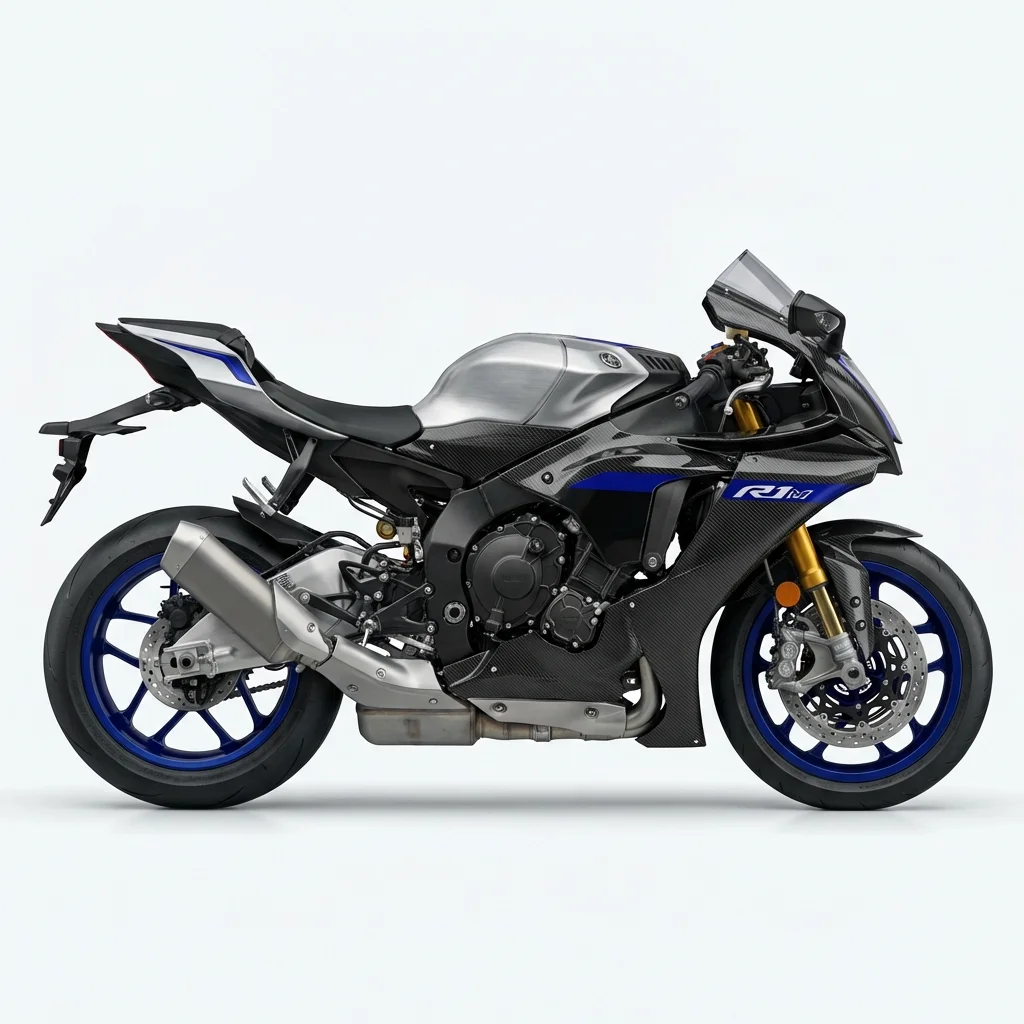
YZF-R1M
$27,399
*Product specifications and price may vary; this is an approximate reference.
Full Specifications
| Engine | 998cc liquid-cooled inline 4-cylinder; DOHC; 16 valves (Crossplane Crankshaft) |
| Displacement | 998cc |
| Power | 197 HP |
| Torque | 113.3 Nm / 84 lb-ft |
| Weight | 202 kg (445 lbs) wet |
| Seat Height | 860 mm / 33.9" |
| Fuel Capacity | 17L / 4.5 gal |
| Transmission | 6-speed with Quick Shift System (QSS) |
| Fuel Type | Gasoline |
Electronics
Rider Modes
Performance & Efficiency
- Top Speed
- 186 mph
- 0-60 mph
- 2.9 sec
Reliability & Ownership
Reliability Yamaha’s CP4 powerplant is renowned for its durability under extreme conditions. While the R1M is a high-strung race machine, its mechanical integrity is superior to many European counterparts. The primary concern for owners is the valve clearance interval, which is set at 26,600 miles. However, the sophisticated Öhlins electronic suspension requires professional servicing to maintain its active damping performance and sensor accuracy over long-term ownership.
Maintenance Oil changes every 4,000 miles; Valve clearance checks every 26,600 miles; Annual electronic diagnostic check.
Comfort & Ergonomics
The R1M is an uncompromising track weapon with ergonomics to match. The 860mm seat height is tall, pushing the rider into a committed, forward-leaning stance. While the carbon fiber bodywork aids in aerodynamics, heat management from the under-seat exhaust routing can be felt in stop-and-go traffic. However, the semi-active Öhlins suspension provides a surprising level of 'Street' compliance when dialed back from its stiffest racing presets.
Overview
" The Carbon-Clad Surgeon "
The Yamaha R1M isn't just a motorcycle; it’s a technological manifesto. Positioned as the halo model of the R-series, the M-spec variant elevates the standard R1 with a full carbon fiber fairing, an aluminum polished swingarm, and the crown jewel: Öhlins Electronic Racing Suspension (ERS). Powered by the legendary 998cc Crossplane (CP4) engine, it delivers a distinct, guttural exhaust note and a power delivery that mimics a V4's tractability with an inline-four's top-end scream. Since its 2015 overhaul, the R1M has defined the digital age of motorcycling, utilizing a 6-axis IMU to govern a suite of aids that make 200 horsepower feel manageable. For those seeking the closest possible connection to Fabio Quartararo’s M1, the R1M stands as the definitive choice in the liter-bike class.
WikiMoto Verdict
"The ultimate expression of Yamaha racing DNA, offering MotoGP levels of feedback for the serious track enthusiast."
In-Depth Review
Engine: The Heart of the Beast
The soul of the R1M is its 998cc CP4 engine. Unlike traditional inline-fours that can feel clinical, the Crossplane crankshaft’s uneven firing order (270°—180°—90°—180°) provides a visceral, connected feel between the throttle and the rear tire. On track, this translates to incredible drive out of corners. The power is linear and relentless, building to a screaming 197 HP peak. The 2024 model continues to benefit from the integrated cylinder head and finger-follower valve train, ensuring the engine can sustain high RPMs all day at the circuit. It is, quite simply, one of the most charismatic engines ever put into a production chassis.
Handling: Precision Reimagined
Where the standard R1 is agile, the R1M is telepathic. The Öhlins NPX gas-charged forks and TTX30 rear shock are governed by the latest Smart EC 2.0 system. This setup constantly adjusts damping in real-time based on the IMU data. Under hard braking, the forks stiffen to prevent dive; under acceleration, the rear firms up to maintain geometry. This creates a platform that feels incredibly stable, yet flickable. The carbon fiber bodywork isn’t just for show; it reduces weight and adds a level of prestige and rigidity to the machine’s aesthetics. The feedback from the front end is the R1M’s greatest asset, allowing the rider to feel every ripple in the tarmac.
Tech: The Digital Crew Chief
Yamaha was the first to implement a 6-axis IMU in a production bike, and the R1M remains at the cutting edge. The Yamaha Ride Control (YRC) allows for deep customization of Slide Control (SCS), Traction Control (TCS), Lift Control (LIF), and Engine Brake Management (EBM). Perhaps the most impressive feature is the Communication Control Unit (CCU). This data-logging system allows riders to download their track telemetry to a smartphone or tablet, overlaying GPS data with throttle position, lean angle, and gear selection. It effectively gives the privateer rider a digital crew chief to help shave seconds off their lap times.
Verdict: The Pinnacle of the R-Series
The R1M is not a commuter, and it’s arguably too much bike for casual canyon riding. It is a specialized instrument designed for the racetrack. While the price tag is significant, the inclusion of carbon fiber and semi-active suspension—features that would cost thousands to add to a base model—represents a fair value for the performance on tap. It feels more mechanical and connected than its German rivals, and more reliable than its Italian ones. For the rider who demands the absolute best of Japanese engineering, the YZF-R1M remains the gold standard of the 1000cc category.