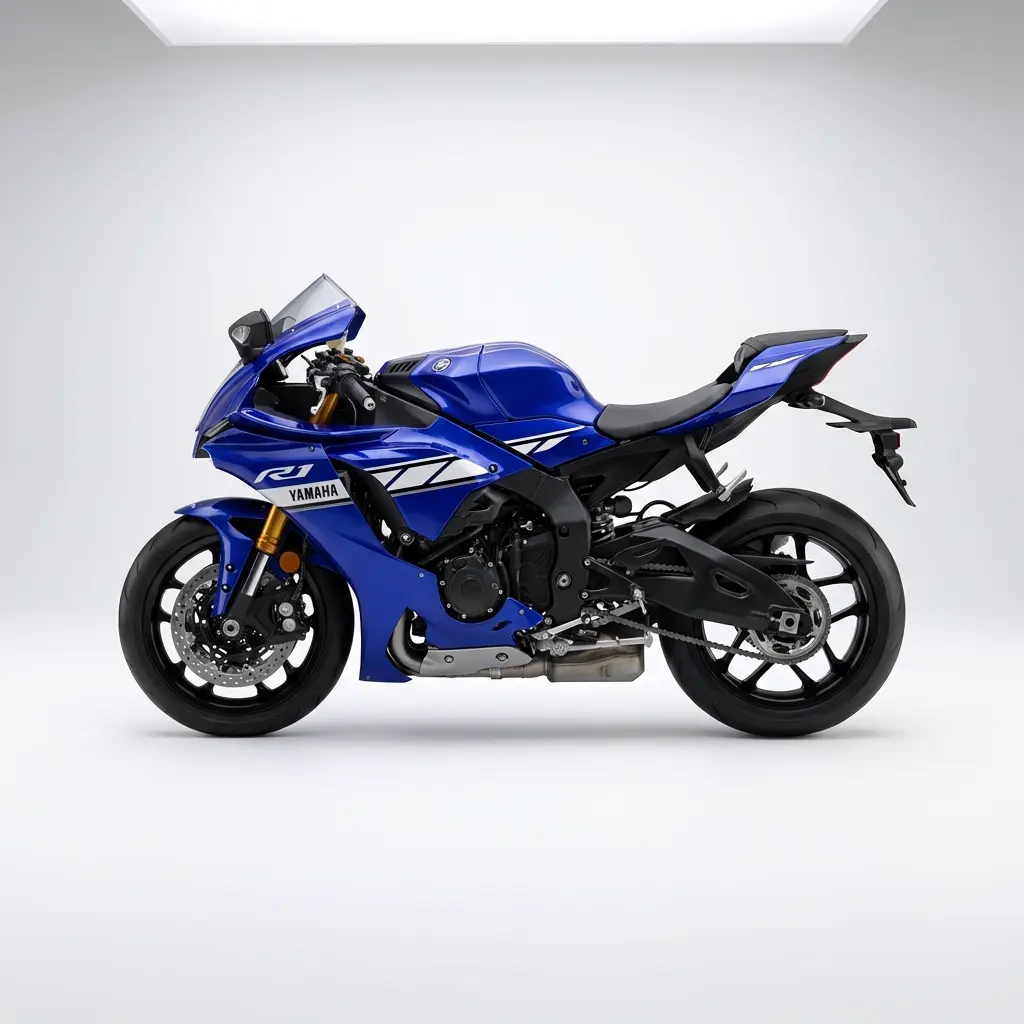
YZF-R1
$18,399
*Product specifications and price may vary; this is an approximate reference.
Full Specifications
| Engine | 998cc liquid-cooled inline 4-cylinder DOHC; 16 valves |
| Displacement | 998cc |
| Power | 198 HP |
| Torque | 113 Nm / 83 lb-ft |
| Weight | 203 kg / 448 lbs |
| Seat Height | 855 mm / 33.7" |
| Fuel Capacity | 17L / 4.5 gal |
| Transmission | 6-speed w/ multiplate slipper clutch; Quick Shift System |
| Fuel Type | Gasoline |
Electronics
Rider Modes
Performance & Efficiency
- Top Speed
- 186 mph
- 0-60 mph
- 3.0 sec
Reliability & Ownership
Reliability Yamaha's CP4 engine platform has matured into a remarkably reliable powerhouse. While it is a high-performance machine, it lacks the finicky nature of some European rivals. The most significant maintenance milestone is the valve clearance check, which occurs at 26,600 miles (42,000 km). Owners report high confidence in the electronics and cooling systems, even under heavy track use, provided the cooling system is kept pristine.
Maintenance Oil and filter every 4,000 miles or annually; Valve clearance checks every 26,600 miles.
Comfort & Ergonomics
The R1 makes no apologies for its ergonomics; it is a committed, track-first geometry. The clip-ons are low and wide, placing significant weight on the wrists, while the rearsets are high to maximize lean angle. Heat management from the under-seat exhaust routing can be felt in stop-and-go traffic. However, the tank shape is excellent for bracing under braking, and the wind protection is surprisingly effective at high speeds.
Overview
" The Crossplane Symphony "
The 2024 Yamaha YZF-R1 remains a pinnacle of the liter-bike class, not just for its raw speed, but for the unique character of its 'Crossplane' crankshaft engine. Derived from the M1 MotoGP bike, the R1 offers a connection between the throttle and the rear tire that is arguably the most tactile in the industry. As the industry shifts toward more digitized and sanitized experiences, the R1 stands as a mechanical masterpiece that requires—and rewards—a skilled hand. It is a bike that feels alive, vibrating with a distinctive 270-180-90-180 firing order that mimics the grunt of a V4 with the top-end rush of an inline-four. For 2024, it continues to be the weapon of choice for riders who value feedback and heritage over spec-sheet bragging rights.
WikiMoto Verdict
"The purest expression of MotoGP technology available for the street, defined by its haunting exhaust note."
In-Depth Review
Engine: The Heart of the Beast
The centerpiece of the YZF-R1 is, and always will be, the CP4 engine. Unlike traditional inline-fours that have a ‘screamer’ firing interval, the R1 uses an uneven firing order. This reduces inertial crankshaft torque, allowing the rider to feel exactly how much grip is available at the rear tire. On the road, this translates to a bike that sounds like a growling beast at low RPMs and transforms into a screaming banshee past 10,000 RPM. The power delivery is linear and predictable, but it pulls with a ferocity that demands respect. Whether you are powering out of a second-gear apex or clicking through the gears on a long straight, the engine never feels strained; it feels like it’s in its natural element.
Handling: Precision Over Everything
Yamaha has perfected the aluminum Deltabox frame over decades, and the 2024 R1 is the most refined iteration yet. It is a physically small bike, feeling more like a 600cc machine between your knees. This compactness makes it incredibly easy to flick into corners. The KYB front forks and rear shock are tuned for the track—stiff, communicative, and composed. While they can be harsh on broken pavement, on a smooth ribbon of asphalt or a circuit, they provide a level of front-end confidence that is second to none. The magnesium wheels, which come standard, reduce unsprung weight, contributing to the bike’s eagerness to change direction. The braking system, featuring 4-piston radial calipers, offers immense stopping power, though some riders may swap the rubber lines for braided steel for even better lever feel during track days.
Tech: The Digital Bodyguard
The R1 was one of the first production bikes to utilize a 6-axis IMU, and its suite of electronics remains world-class. The Engine Brake Management (EBM) and Brake Control (BC) systems allow you to tailor the bike’s behavior into corners, while the Slide Control System (SCS) is a direct hand-down from MotoGP. The TFT display is clear, though it is starting to look a bit small compared to the ‘iPad-style’ screens on European competitors. However, the menus are intuitive, and the ability to adjust settings on the fly via the handlebar toggles is seamless. The Quick Shift System (QSS) is buttery smooth on upshifts and provides perfectly blipped downshifts, keeping the chassis stable under heavy deceleration.
Verdict
The 2024 Yamaha YZF-R1 is a specialist’s tool. It is not a commuter, and it is certainly not a touring bike. It is a machine built for the pursuit of lap times and the visceral joy of a high-performance engine. While rivals might offer more peak horsepower or more gadgets, the R1 offers ‘soul’—a rare commodity in the modern sportbike era. It is a mechanical tribute to Yamaha’s racing success and remains one of the most rewarding motorcycles ever built.