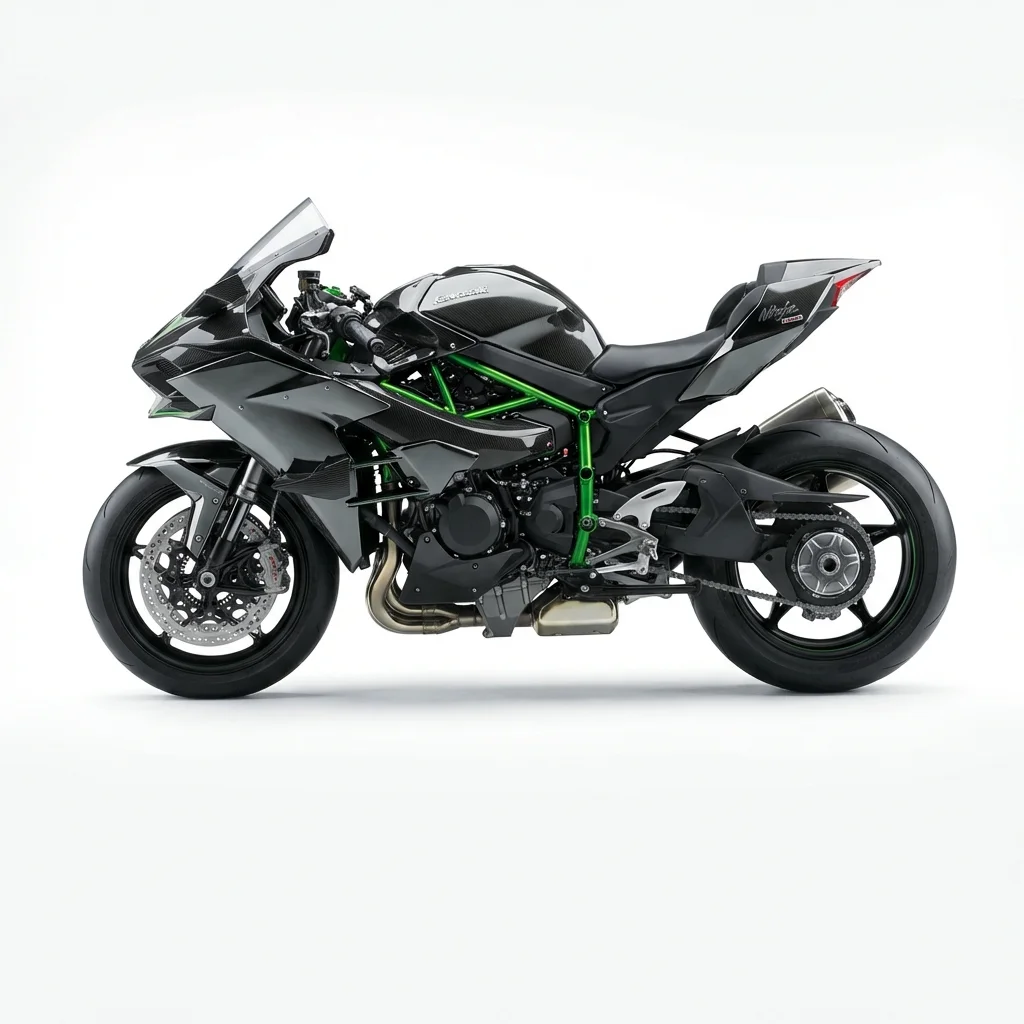
Ninja H2R
$58,100
*Product specifications and price may vary; this is an approximate reference.
Full Specifications
| Engine | 998cc Liquid-cooled, 4-stroke, In-Line Four, Supercharged |
| Displacement | 998cc |
| Power | 326 HP (with Ram Air) |
| Torque | 165 Nm / 122 lb-ft |
| Weight | 216 kg / 476 lbs |
| Seat Height | 830 mm / 32.7" |
| Fuel Capacity | 17L / 4.5 gal |
| Transmission | 6-speed, Return, Dog-ring with KQS |
| Fuel Type | Gasoline |
Electronics
Rider Modes
Performance & Efficiency
- Top Speed
- 249 mph
- 0-60 mph
- 2.2 sec
Reliability & Ownership
Reliability The H2R is a high-strung masterpiece built with aerospace-grade precision. However, it is not a daily commuter. The engine requires intensive inspections every 15 hours of operation above 8,000 RPM. Valve clearances are tight, and the centrifugal supercharger is a precision instrument that demands strict adherence to service intervals. While mechanically robust for its output, it is fundamentally a high-maintenance race machine.
Maintenance Oil changes every 15 hours of track use or annually; Supercharger inspection every 15 hours over 8k RPM.
Comfort & Ergonomics
Comfort is a secondary concern to aerodynamic efficiency. The rider is locked into a committed, aggressive tuck designed to fight wind resistance at 200+ mph. Heat management is impressive for a forced-induction engine, but the cockpit remains a hot environment during slow laps. The carbon fiber bodywork and 'wings' provide stability, which translates to a sense of security, if not physical plushness.
Overview
" The Earth-Shaker "
The Kawasaki Ninja H2R is not just a motorcycle; it is a statement of technical dominance from Kawasaki Heavy Industries. Developed in collaboration with the Aerospace and Gas Turbine divisions, the H2R represents the absolute pinnacle of forced-induction performance. It is a closed-course-only weapon that defies conventional categorization, producing over 300 horsepower from a 1.0-liter engine. Every detail, from the self-healing Silver-Mirror paint to the carbon fiber winglets that generate downforce, is designed for one purpose: shattering speed records. It is the only production bike that truly requires a pilot's license rather than a motorcycle endorsement, offering an experience of acceleration that is physically taxing and mentally overwhelming. It remains the undisputed king of the hypersport world, a halo bike that will likely never be repeated in an era of increasing electrification.
WikiMoto Verdict
"The ultimate expression of internal combustion and aerodynamic science."
In-Depth Review
Engine
The heart of the Ninja H2R is its centrifugal, gear-driven supercharger, which is a marvel of efficiency. Unlike aftermarket turbochargers that suffer from lag, the H2R’s supercharger is driven directly by the crankshaft, providing instantaneous, linear, and utterly violent power delivery from the moment you twist the grip. At full chat, the impeller spins at nearly 130,000 RPM, forcing air into the pressurized plenum with such force that the intake creates a signature ‘chirp’ when the blow-off valve releases. The result is 326 horsepower (with Ram Air) that can propel the bike to 249 mph. The power isn’t just high; it’s high-quality. The fueling is precise, allowing for a surprising amount of control, though the sheer volume of torque means you are constantly battling physics to keep the front wheel on the tarmac.
Handling
You might expect a 300+ horsepower bike to be a ‘straight-line only’ dragster, but the H2R is surprisingly surgical. Kawasaki opted for a trellis frame—a departure from their usual twin-spar design—to allow for better heat dissipation and a specific amount of controlled flex. This frame, combined with the top-tier Ohlins TTX36 rear shock and Brembo Stylema calipers, allows the H2R to navigate corners with genuine poise. The carbon fiber wings aren’t just for show; they produce significant downforce at high speeds, pinning the front end down and providing the stability needed to keep the bike from taking flight. However, the weight is felt in tight transitions; this is a bike that prefers high-speed sweepers where its aerodynamic package can truly shine.
Tech
The electronics suite on the H2R is essentially a safety net designed to keep the rider from being overwhelmed. The Bosch 6-axis IMU manages a sophisticated Traction Control (KTRC), Launch Control (KLCM), and Engine Brake Control (KEBC). The KIBS (Kawasaki Intelligent anti-lock Brake System) is tuned for track use, ensuring that even under extreme braking from 200 mph, the chassis remains settled. The dash is a mix of analog and digital, focusing on boost pressure and lap times. While it lacks the full-color TFT screens of some modern liter-bikes, it feels purposeful and industrial. The ‘Self-Healing’ paint is another tech highlight, using a chemical reaction to ‘heal’ small scratches, keeping the mirror finish pristine.
Verdict
The Kawasaki Ninja H2R is a terrifying, beautiful, and unnecessary masterpiece. It serves no practical purpose—it cannot be ridden on the street, and it is too powerful for almost any sanctioned racing class. Yet, its existence is vital. It represents the limit of what a manufacturer can achieve when they stop worrying about regulations and focus entirely on performance. If you have the means, the skill, and access to a very long runway, there is no other experience on two wheels that can match the visceral, ear-splitting, and soul-shaking acceleration of the H2R. It is the ultimate trophy bike, a mechanical legend that will be talked about for decades.